
(866)7-SWORDS (779-6737) 
Free Shipping on Orders more than $300! (Continental U.S. Only)
Expedited Shipping Available! Call or E-mail us at service@strongblade.com
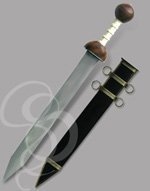
Large Mainz Gladius With Wooden Sheath


- Gorgeous, Wasp-Waisted High Carbon Steel Blade
- New Micrograin Leather Grip for Comfort
- Polished Hardwood Pommel and Guard
- Fantastic Craftsmanship -- Strongblade Exclusive
- Polished Hardwood Sheath with Roman Eagle Pictograph
Product Description
We are sorry but this item is no longer available.
This Strongblade exclusive is a work of art. Designed by Strongblade's lead weapon architect, Alejandro Calas, this Mainz gladius is truly one of the coolest Roman swords we sell.This piece features a gorgeous, slightly exaggerated wasp-waisted blade. The dramatic curves on the hand-crafted blade lend this sword a much more dramatic (and downright frightening) appearance. Something about that deep taper in the center that makes the sword look like it could do much more damage than a regular straight blade. But don't just take our word for how fierce this thing looks. Print out one of the photos of it and hide in a relative's or friend's closet. When your victim enters the room, jump out and scream with the picture held out in front of you. I guarantee the person will scream and jump at least a foot in the air.
Historically accurate in a great many respects, this Mainz-Fulham features the typical squashed-sphere pommel and guard made from polished hardwood. The brass shockplate under the guard is also historically accurate, as is the full tang that runs the length of the hilt.
The grip on this sword is made from hardwood, carved into smooth finger humps (no jokes about finger humping please) and wrapped with a new micrograin black leather that makes for a fantastic gripping surface. A powerful, historically accurate sunken bolt holds this sword together and gives it amazing strength and durability.
A custom-made scabbard of polished hardwood with brass accents and a Roman eagle pictograph in brass are included with this sword.
Product Details
Hand-Forged, Wasp-Waisted High-Carbon Steel BladeMicrograin Leather-Wrapped Grip
Polished Hardwood Pommel and Guard
Polished Hardwood Sheath
Dimensions:
Overall Length: 30 inches
Blade Length: 22.5 inches
Related Items
Roman Gladius Type III with Double Loop Scabbard
 © Copyright 2005-2026 Strongblade LLC