
(866)7-SWORDS (779-6737) 
Free Shipping on Orders more than $300! (Continental U.S. Only)
Expedited Shipping Available! Call or E-mail us at service@strongblade.com
Persian Prince War Scimitar
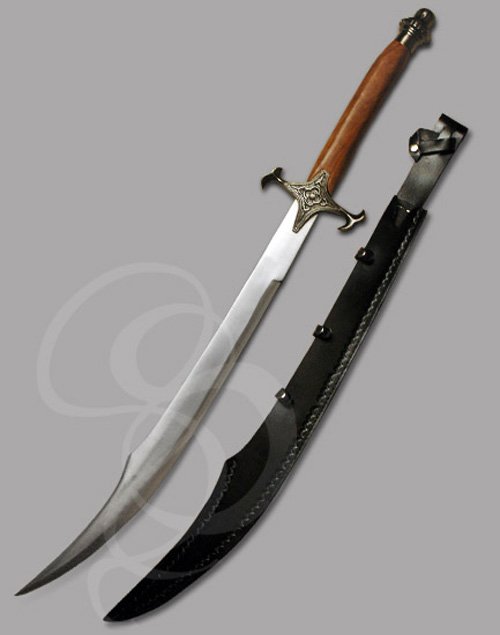


- Devastating Barbed Tip
- Massive Two-Handed Hardwood Grip
- Sculpted Pewter or Gold Cross and Pommel
- Side-Entry Leather Sheath
To Order
Model No.
Price
Availability*
Description
* Stock items ship from Strongblade in 1-3 business days. Please allow additonal 2 to 5 business days for engraving or sharpening.
Product Description
This is a scratch and dent item. We have found that a large number of these swords have minor imperfections and blemishes along the blade. We have lowered the price so at the new low price this sword is a wonderful value.
An excellent combination of fantasy and history, this scimitar (Or Scimetar for the spelling imnpaired) is a must have for fans of the curved sword.
The tapered blade has a wonderfully subtle curve to it, with a wicked barbing tip. The blade is Stainless Steel, so it's light enough to carry for extended periods, and wonderfully balanced for easy swings.
The hardwood handle provides ample space for a wide two-handed grip, even though the sword is light enough to swing in one hand. An embossed pewter guard and a carved pewter pommel round out the scmitar nicely, givng it the royal touch.
The scimitar comes with a leather side-entry sheath, designed specifically for this weapon.
An excellent combination of fantasy and history, this scimitar (Or Scimetar for the spelling imnpaired) is a must have for fans of the curved sword.
The tapered blade has a wonderfully subtle curve to it, with a wicked barbing tip. The blade is Stainless Steel, so it's light enough to carry for extended periods, and wonderfully balanced for easy swings.
The hardwood handle provides ample space for a wide two-handed grip, even though the sword is light enough to swing in one hand. An embossed pewter guard and a carved pewter pommel round out the scmitar nicely, givng it the royal touch.
The scimitar comes with a leather side-entry sheath, designed specifically for this weapon.
Product Details
Wicked Stainless Steel BladeEmbossed Pewter or Gold Guard and Pommel
Big-assed Hardwood Handle
Leather Side-Entry Sheath
Dimensions:
Pewter:
Overall Length: 39 inches
Blade Length: 24 1/4 inches
Gold:
Overall Length: 46.5 inches
Blade Length: 34 inches
Related Items
The Firedancer - Fully balanced, hand-forged, tempered scimitar
 © Copyright 2005-2026 Strongblade LLC