
(866)7-SWORDS (779-6737) 
Free Shipping on Orders more than $300! (Continental U.S. Only)
Expedited Shipping Available! Call or E-mail us at service@strongblade.com
Tenth Legion Roman Tribune Gladius
With Decorative Sheath
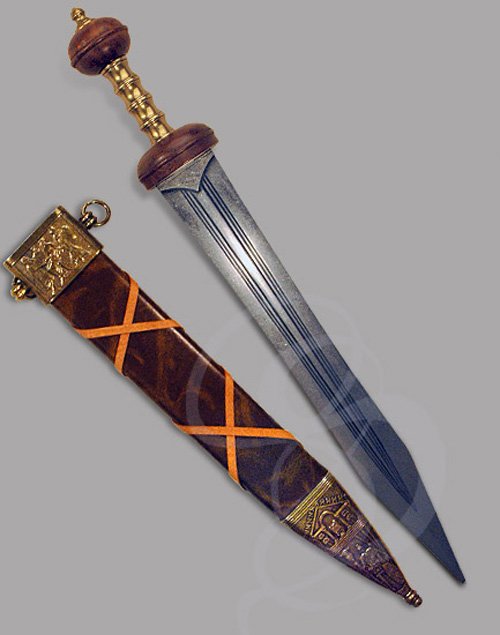


- Masterfully Crafted in Spain
- Ornate Hilt and Sheath
- Antiqued Metal Alloy Used for Blade
- Waisted Blade Has Fuller and Decorative Line Etches
- Sheath Engraved with Roman Eagle, Standard Bearer and More
To Order
Model No.
Price
Availability*
Description
* Stock items ship from Strongblade in 1-3 business days. Please allow additonal 2 to 5 business days for engraving or sharpening.
Product Description
A tribune was a high ranking officer in the Roman Legions. In fact, A Trinune often was (or eventually became) a Legion Commander. Such an important officer would surely have carried a beautiful weapon. Particularly an officer in Julius Caeser's beloved Tenth Legion (Legio X). This gladius is reminiscent of the type of swords that such important officers would have been issued.
This is one of the most attractive gladiuses that we carry. It's a handsome wash of brass and wood-styling, alloy and leather. Although the sword boasts loads of fancy engravings and designs, the focal point is the dark metal blade. It features a waisted design (waisted, not wasted, you lush), meaning that it tapers slightly toward the center, then flares outward again. This would have allowed the sword to slide deeply into a body, using the momentum created by the Famed "V" tip. The blade, made from a weathered, antiqued metal alloy, features six thin fuller lines that follow the sword's taper and join near tip, echoing the vicious "V" that made this weapon so good for thrusting.
The wood-style pommel and guard are beveled smartly and are held in place with brass; A complex brass pommel extension and a ridged brass grip.
Just as stunning as the sword is the sheath. It features ornate brass throat and tip plates, both carved with scenes of Roman Glory. The throat bears an anachronistic image of Emperor Augustus, Caesar's Nephew, seated on a throne, surrounded by the avatar of War and Victory; General Tiberius stands before him, having just achieved victory in the Alpine victory of 16 B.C.E., and offering a gift to the emperor. This scene is from an actual gladius that was unearthed in Britain and now sits in the British Museum of London. The tip of the sheath is engraved with a Roman Standard bearer (an "Aquilifer" for those of you in the local Latin club), and a Roman Eagle. The sheath has a pair of stylish brass belt hoops which make it insanely easy to don. It also features two crossed straps just to make it look that much cooler. Crossed straps? Hmm.... they form Xs. Coincidence? We think NOT.
This is purely a decorative weeapon, but one of the nicest galdiuses we've ever seen. Great for display, better for costumes or uniforms.
This is one of the most attractive gladiuses that we carry. It's a handsome wash of brass and wood-styling, alloy and leather. Although the sword boasts loads of fancy engravings and designs, the focal point is the dark metal blade. It features a waisted design (waisted, not wasted, you lush), meaning that it tapers slightly toward the center, then flares outward again. This would have allowed the sword to slide deeply into a body, using the momentum created by the Famed "V" tip. The blade, made from a weathered, antiqued metal alloy, features six thin fuller lines that follow the sword's taper and join near tip, echoing the vicious "V" that made this weapon so good for thrusting.
The wood-style pommel and guard are beveled smartly and are held in place with brass; A complex brass pommel extension and a ridged brass grip.
Just as stunning as the sword is the sheath. It features ornate brass throat and tip plates, both carved with scenes of Roman Glory. The throat bears an anachronistic image of Emperor Augustus, Caesar's Nephew, seated on a throne, surrounded by the avatar of War and Victory; General Tiberius stands before him, having just achieved victory in the Alpine victory of 16 B.C.E., and offering a gift to the emperor. This scene is from an actual gladius that was unearthed in Britain and now sits in the British Museum of London. The tip of the sheath is engraved with a Roman Standard bearer (an "Aquilifer" for those of you in the local Latin club), and a Roman Eagle. The sheath has a pair of stylish brass belt hoops which make it insanely easy to don. It also features two crossed straps just to make it look that much cooler. Crossed straps? Hmm.... they form Xs. Coincidence? We think NOT.
This is purely a decorative weeapon, but one of the nicest galdiuses we've ever seen. Great for display, better for costumes or uniforms.
Product Details
Overall Length: 27 3/4"Blade Length: 20 1/4"
Weight: 2lbs 8oz
Zinc Alloy Blade (unsharpened), Wood and Brass Accents, Gilded Accents on Throat and Tip of Sheath.
 © Copyright 2005-2026 Strongblade LLC