
(866)7-SWORDS (779-6737) 
Free Shipping on Orders more than $300! (Continental U.S. Only)
Expedited Shipping Available! Call or E-mail us at service@strongblade.com
Hand-forged, Battle Ready Pirate Sword


- Breathtakingly Savage Weapon
- Fully Tempered and Battle Ready
- Blade Features an Impressively Swept Tip
- Bell Guard is Pierced with Skull and Crossbones
- One of the Finest Pirate Swords We Sell
To Order
Model No.
Price
Availability*
Description
* Stock items ship from Strongblade in 1-3 business days. Please allow additonal 2 to 5 business days for engraving or sharpening.
Product Description
The Deathknell is a great combination of unique savagery and familiar pirate themes. It�s like seeing an Asian pirate who looks just like Blackbeard but knows killer martial arts. Or maybe a female Jack Sparrow who is gorgeous and can crush you between her thighs like Famke Janssen could in that James Bond movie. But enough about my fantasies. We�re here to talk about one of the finest battle-ready pirate swords that we offer.
The Deathknell starts off with your standard naval cutlass blade. But somewhere near the tip, it gets all scimitarish and what not, with a cruel looking hook (I believe the term is a yelman and a point that gives me interior bleeding just looking at it.
The blade is hand-forged, beautifully tempered high-carbon steel, and is available sharpened or non-sharpened. It sports a narrow, deep fuller along three-quarters of its 26-inch length (That�s a bit of a confusing sentence. Take your time and read it again. I�ll wait.)
Just to make sure that no one can doubt your piratical tendencies, the black bell-guard is pierced with the never-mistaken sign of the skull and crossbones. The comfortable grip is made from wood, wrapped in high-grade leather, and then finished with braided wire. The sword comes with a blood red, leather-wrapped wood scabbard. All of the metal parts of the sword and scabbard are antiqued for that boat cred that all pirates demand these days.
The Deathknell starts off with your standard naval cutlass blade. But somewhere near the tip, it gets all scimitarish and what not, with a cruel looking hook (I believe the term is a yelman and a point that gives me interior bleeding just looking at it.
Just to make sure that no one can doubt your piratical tendencies, the black bell-guard is pierced with the never-mistaken sign of the skull and crossbones. The comfortable grip is made from wood, wrapped in high-grade leather, and then finished with braided wire. The sword comes with a blood red, leather-wrapped wood scabbard. All of the metal parts of the sword and scabbard are antiqued for that boat cred that all pirates demand these days.
Product Details
Materials: Hand-forged, tempered, high-carbon steel.Overall Length: 32 3⁄4"
Blade Length: 25 3⁄4"
Weight: 2lbs 6oz
Comes with leather-wrapped wooden scabbard
Related Items
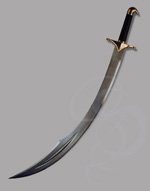
The Firedancer - Fully balanced, hand-forged, tempered scimitar
 © Copyright 2005-2026 Strongblade LLC