

Categories
- New Arrivals
- Armor
- Axes & Maces
- Bargains
- Clothing
Costumes - Collectibles
- Daggers
- Displays
- Engravable Items
- Flintlocks & Projectile
- Jewelry
- Kids Stuff
- Knives
- Larp and Foam
- Lightsabers
- Letter Openers
- Military Replicas
- Movie &
Licensed Items - Shields
- SpearsPolearms
- Strangeblade
Strange & Unusual
Stuff - Swords
- Tankards &
Goblets - Browse All Products
Medieval Arming Swords
When someone refers to a medieval sword, they are generally speaking of a sword that would have been carried by either a knight or a soldier during the Middle Ages. Although the exact start and end dates of the medieval age has been disputed for years, all Strongblade references (unless otherwise noted) refer to the period between 500 A.D. (around the time the Roman Empire was ending) to about 1500 AD (around the time when the renaissance was beginning).
The knight and his arming sword were inseparable. Though a knight might switch other weapons throughout his life and even during a single battle, the arming sword was his for life. In fact, it was likely that a knight would go through more wives than arming swords, and, when you consider that arming swords were often handed down from generation to generation, it's quite possible that an entire family tree would use the same sword.
Because of this, arming swords were much more than just weapons. They became symbols of the men who carried them. Badges of honor, symbols of rank and nobility, and messages to all that the bearer was both a gentleman and warrior; that he could save your soul or take it in an instant.
The relationship between the knight and his arming sword was similar, if not so religious, as the relationship between a samurai and his katana. Knights would have sacred or other meaningful words inscribed into the blades of their swords, inlaid with silver or gold. These words served as both an inspiration and personal motto for them. Occasionally, knights would rent out space on their swords to local merchants, and would, with each kill, proclaim "This death was brought to you by Samuel's Bake Shop, where you don't have to spend a lot of bread to get a loaf" or something similar. Actually, I don't think those last two sentences are true, but it would have been a good way for the knights to raise money for their church, now wouldn't it?
As mentioned, arming swords were handed down from generation to generation. The swords, used in combat, often suffered damage or breakage, so the blade would be refitted, or a new pommel would be attached, or perhaps a new grip would be added to replace an old worn one. It's possible that the sword a great-great grandson bore no longer resembled the original.
Arming swords in warfare were used mostly as backup weapons for lances and much larger battle swords. The knight would draw these swords when dismounted, or when his other weapons were lost or broken. The arming sword, however, would have been used quite often in one-on-one combat and in smaller scale combats. In some tourneys, knights would first joust with lances, then, when unseated, would draw their arming sword and continue the combat.
Medieval swords almost always have pommels (often using a variation of the standard "disk" pommel), usually have well defined crosses (or quillons), and typically have long fullers (indented grooves running along the blade). Of the many medieval swords that have been excavated or found, quite a few have engravings on the blades. Usually, these engravings were of a religious nature, with sacred phrases or sketches etched into the blade and usually filled with another metal, like silver.
The most common forging technique during the early medieval ages was known as "Pattern Welding." This is a technique of folding metal and grinding/pounding it down into itself repeatedly. Pattern-welding caused visible "waves" and patterns in the metal, thus giving it its name. Asian (particularly Japanese) smiths took this technique further, and are generally regarded as having "perfected" the style, although Japanese forging techniques are quite different from the original pattern welding of the middle ages.
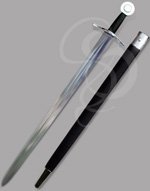 An excellent example of an arming sword is this stylish medieval
knight's sword.
Click the image to see what a REAL man wears when he goes out (or what women really want
against their waist).
An excellent example of an arming sword is this stylish medieval
knight's sword.
Click the image to see what a REAL man wears when he goes out (or what women really want
against their waist).
 © Copyright 2005-2026 Strongblade LLC