
(866)7-SWORDS (779-6737) 
Free Shipping on Orders more than $300! (Continental U.S. Only)
Expedited Shipping Available! Call or E-mail us at service@strongblade.com
Captain Jack Sparrow's Flintlock Pistol
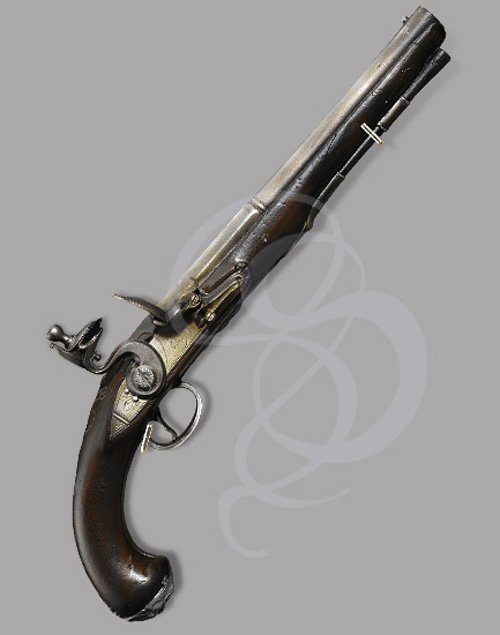


- Exact Non-Firing Replica of Pistol Used by Johnny Depp
- Amazing Historical Accuracy
- Intricately Carved and Detailed
- Elaborate, Antiqued Wall Mounting Frame
- Limited Edition (1 of 3000) with Numbered Plaque
- Arrives May 2006: Pre-order Now
Product Description
We are sorry but this item is no longer available.
Johnny Depp's portrayal of Captain Jack Sparrow in the first Pirates of the Caribbean movie is arguably the most entertaining pirate role in history. Depp is reprising his role in the new Pirates of the Caribbean II: Dead Man's Chest. As in the first movie, he's swinging his trusty cutlass and firing his lethal flintlock.Captain Jack Sparrow is a master swordsman. He's capable of dispatching dozens of opponents with his cutlass, but when he's in a bind, his treasured flintlock pistol can blast him to safety (you'll all remember the usefulness of the flintlock at the end of the swordfight between Sparrow and Will Turner in the first movie...)
This Limited Edition Jack Sparrow Flintlock is a painstakingly crafted replica of the pistol used by Johnny Depp in "Dead Man's Chest." It's been weathered and antiqued to give it the appropriate Bucanneer feel, but is still a beautiful weapon to look at. Two-tone Engraved cast metal accents protect the stock and barrel, and form the loading and firing mechanism. The golden lockplate is masterfully etched with wing-feather patterns. The tumbler screw has a feathered circle pattern (or perhaps a sunflower or starburst) engraved on it. The hammer (or cock for you risque' types) is beveled and stylishly curved; at it's end are cast metal vise jaws that hold a simulated piece of flint-and-cloth pinched between them.
Like the sword, the Jack Sparrow Flintlock comes with a dazzling mounting frame and numbered limited edition plaque (i.e. 5 of 3000). The backing of the frame is wrapped with a pale canvas/burlap that calls to mind billowing sails and creaking masts. The frame itself is a massive piece of artwork with high-adventure waves and swirls carved throughout. Antiqued and weathered, the frame simulates an old treasure, perhaps unearthed in the cellars of a governor's mansion somewhere (or, since we're using our imaginations here, found in an armoire somewhere and bought at a tag sale for $8, then brought to the Antiques Roadshow where it was determined to be worth $6.4 million, auctioned at Christie's for $9.7 million after a bidding war between media moguls, then given as a gift to a mistress and, ultimately, sold to an eccentric Australian tycoon who now hides his safe behind it). Needless to say, the frame sets the imagination to work.
The Jack Sparrow Flintlock Pistol can be mounted on the hanging frame or carried in a belt or bandolier for easy access. It's a stunning weapon for display, or to truly complete any pirate outfit. Less than 3,000 of these are available for the worldwide consumption, so get yours while they last.
Product Details
Overall length: 30" (together)
Diameter: 5"
Blade Material: Weathered Stainless Steel
Grip Material: Antiqued Leather over Wood
Guard/Pommel: Battered Brass
Includes Impressive Mounting Frame and Numbered Plaque
 © Copyright 2005-2026 Strongblade LLC